半导体“钨危机”是真实存在的吗?——通过日韩公开信息交叉验证
小坂知 2026年4月3日 13:05
中国的出口限制、日本制造商的原料短缺、以及韩国行业相关人士的证词。从三个方向的信息交叉验证后,浮现出什么?
报道内容——以及为何事态严重
2026年4月3日,韩国半导体专业媒体《The Elec》发布了一篇独家报道。标题为:《比伊朗的氦气更棘手……半导体行业的“钨危机”》。报道的主要内容如下:
日本六氟化钨(WF6)制造商——关东电化工业和中央玻璃——上周开始通知三星电子、DB HiTek等韩国半导体公司,原料供应将中断。虽然依靠当前的钨库存可以维持到5月或6月,但下半年无法保证。韩方客户公司已被要求寻找替代供应商,如SK Specialty和孝盛。
如果该报道属实,影响将是巨大的。要理解这一点,必须了解WF6在半导体制造中的地位。
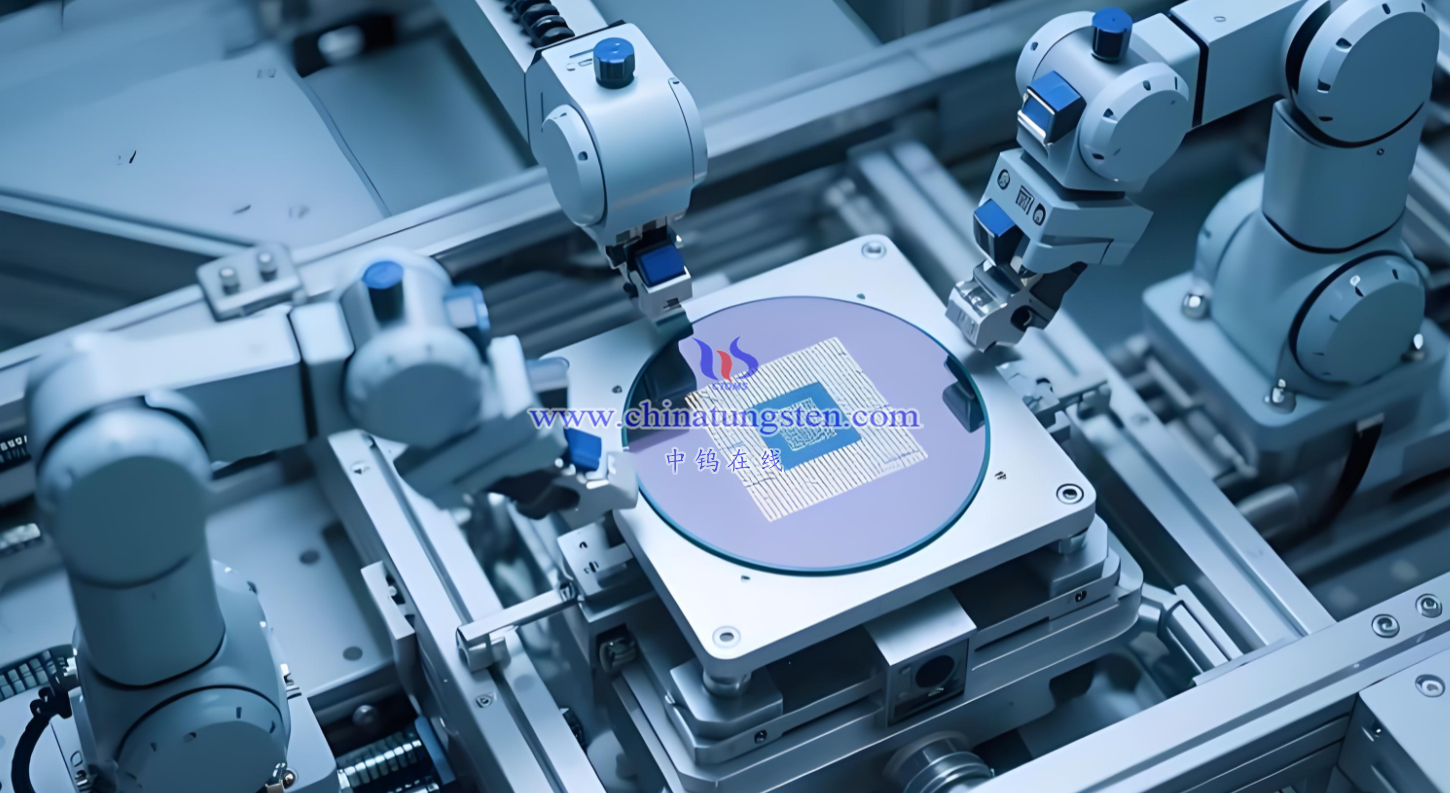
WF6是一种原料气体,用于形成半导体芯片内部电信号传输的“布线”。将WF6气体喷射到晶圆上,通过化学反应生成钨薄膜,该薄膜成为芯片内部的电气通路。
它被用于DRAM、NAND和逻辑半导体,但在3D NAND中消耗量尤其巨大。3D NAND的结构是将存储单元垂直堆叠成许多层,对于当前主流的200层级别产品,钨薄膜沉积工艺必须重复200次。如果无法采购到WF6,就无法进行这种沉积。
而问题的核心在于,用于制造WF6的钨粉有80%产自中国。
WF6制造商从中国进口钨粉,在高温下与氟气反应,然后蒸馏提纯成高纯度气体。一种原料供应80%依赖单一国家的材料,却处于半导体制造的基础地位。这就是该问题的结构性恐怖之处。
在全球WF6供应中,日本的关东电化工业和中央玻璃合计市场份额约为25%。如果《The Elec》的报道属实,意味着全球四分之一的WF6供应将在下半年变得不稳定。
然而,该报道有一个重要的注意事项。关东电化工业和中央玻璃均未就此发布任何官方公告。《The Elec》的文章基于被称为“多位行业内部人士”的匿名消息来源。
那么,我们应在多大程度上相信这篇报道?本文将通过与日本和韩国双方的公开信息进行交叉验证,来核实报道内容。
日方可以确认的事实——钨原料短缺是“真实的”
目前无法确认关东电化工业和中央玻璃关于WF6供应的官方公告。但关于这两家公司所处的钨采购环境,可以从日本的公开信息中获得很多线索。
管制的事实
首先,按时间顺序梳理中国的管制措施。
2025年2月4日,中国政府针对包括钨在内的战略矿产引入出口许可证制度。这涉及仲钨酸铵(APT)、氧化钨、碳化钨等。虽然给出的理由是环境保护和防止资源枯竭,但普遍认为这是针对美国对华半导体管制而采取的反制措施。
2026年1月6日,中国商务部加强了对日本的双用物项(军用和民用)出口管制,即日生效(2026年第1号商务部公告)。直接导火索是高市早苗首相对台湾突发事件的国会答辩。包括路透社、彭博社、CNN、JETRO和CISTEC在内的多家公共机构和新闻媒体均证实了该措施。
钨粉是典型的双用物项,既用于半导体材料,也用于坦克穿甲弹、导弹和飞机部件。换言之,对日本的钨粉出口受到双重管制:2025年2月的许可证制度,以及2026年1月对日的双用物项管制。
此外,2026年2月24日,中国商务部将20家日本公司列入双用物项出口管制名单(2026年第11号和第12号商务部公告)。富士模具已在其面向业务伙伴的文件中明确说明了这一事实。
日本下游企业面临的情况
这些管制实际造成的影响,已由日本钨相关企业的官方公告充分揭示。
日本新金属(JNM)发布了日期为2026年2月1日、题为《关于钨产品订单限制的实施》的重要通知。通知称“由于2025年2月4日公布并实施的中国加强双用出口管制的影响,预计2026财年钨原料采购将持续不稳定”,并宣布对于2026年4月1日起发货的订单,将把订单量限制在上财年业绩的约80%。通知指出,虽然公司正在推进回收材料的使用以及从中国以外地区采购,但完全满足需求将很困难。
Fujilloy于2026年3月18日向业务合作伙伴发布文件称,“由于中国加强出口管制,全球钨供应短缺感强烈,钨价格正创下历史新高”。关于订单增加,公司表示“为优先稳定供应和品质保证,可能需要就订单数量、交货日期及交易条件进行个别协商”,暗示了实质性的供应限制。
硬质合金制造商Sun Alloy Industry在其官方网站上明确宣布,中国对钨的出口管制(2025年2月4日第10号公告)尚未解除。该公司特别发出此警告,是因为容易与部分稀土管制的放宽相混淆。公司使用了“钨相关原料的采购环境依然紧张”的表述。
《化学工业日报》也在2026年3月10日报道称,由于中国对日的双用出口管制,存在钨短缺的担忧。

价格透露的信息
再看数据。
彭博社在2026年3月16日的一篇文章中报道,钨中间原料APT的国际基准价格自2025年2月中国引入出口管制以来已上涨557%。同期,黄金仅上涨47%,铜仅上涨25%,凸显钨的异常走势。
《日本金属日报》报道,截至2026年3月初,APT的国际价格达到每10公斤三氧化钨含量1944美元,自2月初以来上涨41%。稀有金属专业媒体MIRU于4月1日报道,“钨废料价格出现前所未有的飙升”。
此外,由于2026年2月底开始的伊朗战争的影响,军用钨需求激增。根据韩国矿山修复与矿产资源公司(KOMIR)的数据,中国氧化钨价格在战争爆发后短短一个月内上涨了24%。
在此总结一下现状。
关东电化工业和中央玻璃从中国进口钨粉用于制造WF6。这些钨粉受到中国出口许可证制度的约束,且自2026年1月起,还受到对日双用物项管制。使用相同钨原料的其他日本下游企业已正式宣布订单限制,并明确表示“原料采购不稳定”。原料价格在一年内上涨了557%。
在这种环境下,很难相信只有WF6制造商不受影响。虽然没有官方公告,但从周边信息可以合理推断,关东电化和中央玻璃在原料采购上面临严重困难。
韩国报道的脉络——这篇报道并非“突发新闻”
在评估《The Elec》4月3日的报道时,还有另一个重要的视角。这篇报道并非孤立的、一次性信息,而是建立在半年多来持续报道的基础之上。
2025年10月27日,《The Elec》已报道了以下内容:
“SK Specialty、孝盛、关东电化韩国等气体制造商最近向三星电子、SK海力士、DB HiTek、MagnaChip传达了立场,要求从明年起将WF6的供应单价提高70-90%。”
这篇报道包含了具体细节,例如日本气体制造商因汇率要求提价90%、半导体制造商因认可钨价格飙升而接受涨价、全球WF6年消耗量为7000-8000吨、以及各公司产能(SK Specialty 2000吨,孝盛900吨,关东电化1400吨,中船重工第七一八研究所2200吨)。

免责声明
-
关于原文作者及内容
本翻译作品基于原文作者小坂知(こまさか とも)公开发表的文章《Is the Semiconductor “Tungsten Crisis” Real? — Verifying by Cross-Referencing Public Information from Japan and South Korea》进行翻译。原文观点、数据、结论及任何立场均属原作者个人表达,不代表翻译者或本翻译作品的观点。翻译者不对原文信息的真实性、准确性或完整性承担任何责任。 -
关于读者使用
本翻译仅供信息参考之目的,不构成任何投资、商业决策或法律依据。读者应结合原始语言版本及其他权威信息来源进行独立判断。翻译者不对读者基于本翻译内容所作出的任何行为或决策承担任何直接或间接责任。 -
关于翻译质量
翻译者已尽合理努力,力求在忠实原文、专业术语准确性和语言流畅性之间取得平衡。但由于语言、文化及专业领域的差异,本翻译可能存在语义偏差、遗漏或表达不够精确之处。若原文与翻译之间存在歧义或争议,应以原文语言版本为准。欢迎读者指正翻译中的问题,但翻译者不对翻译内容可能引发的任何误解或损失承担责任。

中钨智造科技有限公司有积累了30多年的钨钼金属制品,钨的化学品,如偏钨酸铵、纳米氧化钨、钨酸、铯钨青铜、六氟化钨、二硫化钨等,钨合金、硬质合金等设计生产经验,可以为各类客户提供各类高性能钨材料。任何关于钨钼材料的需求或者相关问题、专业技术和知识,可以联系中钨在线的的钨制品专家交流探讨,中钨智造愿为全球提供中英文双语的设计、生产资讯等服务,联系信息如下:
中钨智造科技有限公司
福建省厦门市软件园二期望海路25号之一3楼
邮编:361008
邮箱:sales@chinatungsten.com
电话: 0086 592 5129696 / 0086 592 5129595
网址:www.tungsten.com.cn
+++++++++++++++++++++++++++++++
钨制品最新优惠价格
微信公众号“中钨在线”每日更新钨粉、钨酸铵等各类钨酸盐、钨制品、高比重钨合金、硬质合金、钨精矿等各类钨制品价格,同时提供业内最专业的微信群供大家交流供求信息,可以随时交流钨粉有关信息。关注“中钨在线”,加入中钨在线微信交流群体,每日钨制品价格、供求信息及时送达,实时交流。更多钨制品市场行情,产品与资料,敬请关注“中钨在线”微信公众号,或访问news.chinatungsten.com 获取每日更新资讯。中钨在线联系信息: sales@chinatungsten.com 电话: +86 592 5129696 / 86 592 5129595
扫码关注“中钨在线”微信公众号,每早免费获取实时更新的钨钼稀土制品市场价格和资讯。

附:英文原文
Is the Semiconductor “Tungsten Crisis” Real? — Verifying by Cross-Referencing Public Information from Japan and South Korea
2026.04.03. 13:05
China’s export restrictions, raw material shortages for Japanese manufacturers, and testimonies from South Korean industry sources. What emerges when cross-referencing information from three directions.
- What was reported—and why it is serious
On April 3, 2026, The Elec, a South Korean media outlet specializing in semiconductors, published an exclusive article. The headline read: “More problematic than helium from Iran… ‘Tungsten Crisis’ in the semiconductor industry.” The gist of the article is as follows:
Japanese WF6 (tungsten hexafluoride) manufacturers, Kanto Denka Kogyo and Central Glass, began notifying South Korean semiconductor companies such as Samsung Electronics and DB HiTek last week that raw material supplies would be cut off. While supply can be maintained with current tungsten inventory until May or June, the second half of the year cannot be guaranteed. South Korean client companies have been requested to look for alternative suppliers such as SK Specialty and Foosung.
If this report is true, the impact will be enormous. To understand why, one must know the position that the material WF6 occupies in semiconductor manufacturing.
WF6 is a raw material gas used to form the “wiring” through which electrical signals travel inside a semiconductor chip. WF6 gas is sprayed onto a wafer, and a thin film of tungsten is created through a chemical reaction. This film becomes the electrical pathway within the chip.
It is used in DRAM, NAND, and logic semiconductors, but it is consumed in overwhelmingly large quantities in 3D NAND. 3D NAND has a structure where memory cells are stacked vertically in many layers, and for current mainstream 200-layer class products, the tungsten film deposition process must be repeated 200 times. If WF6 cannot be procured, this deposition cannot be performed.
And the core of the problem is the fact that 80% of the tungsten powder used to make WF6 is produced in China.
WF6 manufacturers import tungsten powder from China, react it with fluorine gas at high temperatures, and then distill and refine it into high-purity gas. A material for which 80% of raw material supply depends on a single country is positioned at the foundation of semiconductor manufacturing. This is the structural terror of this issue.
In global WF6 supply, Japan’s Kanto Denka Kogyo and Central Glass are said to have a combined market share of approximately 25%. If The Elec’s report is true, it means that one-quarter of the world’s WF6 supply will become unstable in the second half of the year.
However, there is an important caveat to this report. Neither Kanto Denka Kogyo nor Central Glass has made an official announcement regarding this matter. The Elec’s article is based on anonymous sources described as “multiple industry insiders.”
So, how much should we believe this report? In this article, we will verify the claims by cross-referencing public information from both the Japanese and South Korean sides.
- What can be confirmed on the Japanese side—the shortage of tungsten raw materials is a “fact”
Official announcements regarding WF6 supply from Kanto Denka Kogyo and Central Glass cannot be confirmed at this time. However, much can be gleaned from Japanese public information regarding the tungsten procurement environment surrounding these two companies.
The facts of the regulations
First, let’s organize the Chinese regulations chronologically.
On February 4, 2025, the Chinese government introduced an export licensing system for strategic minerals, including tungsten. This covers APT (ammonium paratungstate), tungsten oxide, tungsten carbide, and others. While environmental protection and the prevention of resource depletion were cited as the reasons, it is widely viewed as a countermeasure against U.S. semiconductor regulations targeting China.
On January 6, 2026, the Chinese Ministry of Commerce strengthened export controls on dual-use (military and civilian) items destined for Japan, effective immediately (Ministry of Commerce Announcement No. 1 of 2026). The direct trigger was Prime Minister Sanae Takaichi’s parliamentary response regarding a Taiwan contingency. Multiple public institutions and news organizations, including Reuters, Bloomberg, CNN, JETRO, and CISTEC, have confirmed this measure.
Tungsten powder is a typical dual-use item that is both a semiconductor material and used in tank armor-piercing shells, missiles, and aircraft parts. In other words, exports of tungsten powder to Japan became subject to dual regulations: the licensing system of February 2025 and the dual-use regulations against Japan of January 2026.
Furthermore, on February 24, 2026, the Chinese Ministry of Commerce added 20 Japanese companies to its export control list for dual-use products (Ministry of Commerce Announcements No. 11 and No. 12 of 2026). Fuji Die has explicitly stated this fact in documents for its business partners.
What is happening to Japanese downstream companies
What these regulations are actually causing is eloquently told by the official announcements of Japanese tungsten-related companies.
Japan New Metals (JNM) published an important notice dated February 1, 2026, titled “Regarding the Implementation of Order Restrictions for Tungsten Products.” Stating that “due to the impact of China’s strengthened dual-use export controls announced and implemented on February 4, 2025, the procurement of tungsten raw materials is expected to remain unstable in fiscal year 2026,” they announced that they will limit order quantities to approximately 80% of the previous fiscal year’s performance for shipments starting April 1, 2026. They noted that while they are promoting the use of recycled materials and procurement from outside China, it will be difficult to fully meet demand.
Fujilloy released a document for business partners on March 18, 2026, stating, “Due to the strengthening of China’s export controls, there is a strong sense of global tungsten supply shortages, and tungsten prices are trending at record highs.” Regarding the increase in orders, the company stated, “To prioritize stable supply and quality assurance, we may need to consult individually regarding order quantities, delivery dates, and transaction terms,” thereby implying substantial supply constraints.
Cemented carbide manufacturer Sun Alloy Industry has clearly announced on its official website that China’s export controls on tungsten (Announcement No. 10 dated February 4, 2025) have not been lifted. They are issuing this warning specifically because it is easy to confuse this with the suspension of some rare earth regulations. They use the expression, “the procurement environment for tungsten-related raw materials remains tight.”
The Chemical Daily also reported on March 10, 2026, that there are concerns about tungsten shortages due to China’s dual-use export controls against Japan.
What the prices are saying
Let’s also look at the numbers.
Bloomberg reported in an article on March 16, 2026, that the international benchmark price for APT, an intermediate tungsten raw material, has risen 557% since February 2025, when China introduced export controls. During the same period, gold rose only 47% and copper 25%, highlighting the abnormality of tungsten.
Japan Metal Daily reported that as of early March 2026, the international price of APT reached $1,944 per 10kg of WO3 content, a 41% increase since early February. Rare metal specialty media MIRU reported on April 1 that “tungsten scrap prices have recorded an unprecedented surge.”
Furthermore, due to the impact of the Iran War that began at the end of February 2026, demand for tungsten for military use has surged. According to data from the Korea Mine Rehabilitation and Mineral Resources Corporation (KOMIR), the price of Chinese tungsten oxide rose 24% in just one month from immediately before the outbreak of the war.
Let’s summarize the situation here.
Kanto Denka Kogyo and Central Glass import tungsten powder from China to manufacture WF6. That tungsten powder is subject to China’s export licensing system and, as of January 2026, is also subject to dual-use controls against Japan. Japanese downstream companies using the same tungsten raw materials have already officially announced order restrictions and explicitly stated that “raw material procurement is unstable.” Raw material prices have risen 557% in one year.
In this environment, it is difficult to believe that only WF6 manufacturers are unaffected. Although there are no official announcements, it can be reasonably inferred from peripheral information that Kanto Denka and Central Glass are facing serious difficulties in raw material procurement.
- The Genealogy of Korean Reporting — This report is not a “sudden story”
There is another important perspective to consider when evaluating The Elec’s April 3 report. This report is not an isolated, one-off piece of information, but rather built upon more than half a year of accumulated reporting.
On October 27, 2025, The Elec had already reported the following:
“Gas manufacturers such as SK Specialty, Foosung, and Kanto Denka Korea recently conveyed their position to Samsung Electronics, SK Hynix, DB HiTek, and MagnaChip that they need to raise the supply unit price of WF6 by 70-90% starting next year.”
This article included specific figures such as Japanese gas manufacturers demanding a 90% increase due to exchange rates, the atmosphere among semiconductor manufacturers accepting the increase because they recognize the surge in tungsten prices, the annual global consumption of WF6 being 7,000-8,000 tons, and the production capacity of each company (SK Specialty 2,000 tons, Foosung 900 tons, Kanto Denka 1,400 tons, China Peric 2,200 tons).